
Chimney Repair in Lawrence Park, NY: What’s Actually Wrong and Who Should Fix It
A damaged chimney doesn’t announce itself politely. Usually it’s a water stain on the ceiling, a draft that won’t quit, or a piece of mortar sitting in the fireplace that wasn’t there last week. For homeowners in Lawrence Park, those signs tend to appear in late winter or early spring, after the freeze-thaw cycles have had months to work on brick and mortar that may already be decades old. Chimney repair in Lawrence Park, NY is something we handle year-round, and the homes here give us plenty to work with: deep setbacks, older Tudor and Colonial stock, and chimneys that were built well but haven’t always been maintained to match.
This post walks through the problems we see most often, how we actually diagnose them, and what separates a contractor who’ll solve the problem from one who’ll take your money and leave you with the same issue next winter.
The call that started this season
A homeowner on the Lawrence Park side of Bronxville reached out to us in February after noticing white streaking on their exterior chimney and a faint musty smell near the firebox. They’d had a company out the previous fall who patched the crown and left. The smell got worse. When our technician did a Level II inspection, we found the real problem: a cracked flue liner that had been directing water into the chase for at least one full heating season. The crown patch was fine work, but it addressed the symptom and missed the source. We relayed a stainless steel liner and sealed the base, and the smell was gone within two weeks. The homeowner spent more than they’d hoped, but the previous patch had already cost them money on a repair that didn’t repair anything.
The problems we actually find in Lawrence Park homes
Spalling brick and deteriorated mortar joints
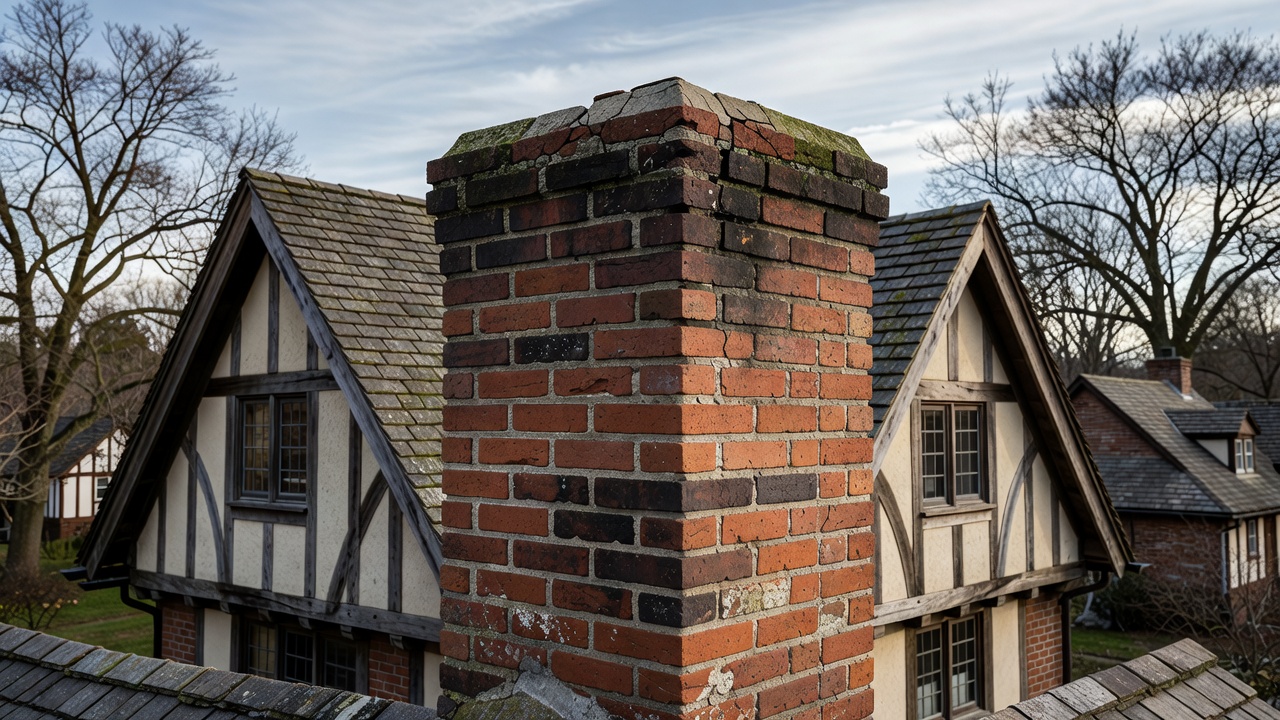
This is the most common thing we see, particularly on chimneys on the north-facing sides of homes in Lawrence Park, Cedar Knolls, and Crestwood. Freeze-thaw cycles pull moisture into porous brick, it expands when it freezes, and the face of the brick pops off. Mortar joints are softer than the brick and they fail first, usually showing as recessed, crumbly lines between courses. The fix is tuckpointing — removing degraded mortar to a consistent depth and packing in fresh Type S mortar that matches the original in composition and color. If the brick itself is spalling, we assess whether individual units can be replaced or whether a larger section needs rebuilding. The diagnostic question we ask is whether the damage is cosmetic or structural. Cosmetic means the flue integrity is intact. Structural means we need to go further before you light another fire.
Cracked or eroded chimney crown
The crown is the concrete cap that seals the top of the chimney stack, and it takes a beating. A crown that was poured too thin, or that has no overhang, cracks under thermal stress and admits water directly into the chase. Homeowners often notice this only after they see water in the firebox during heavy rain. We probe the crown with a pick to feel for soft spots and check the overhang dimension. A hairline crack can sometimes be sealed with a flexible elastomeric coating. A crown that’s soft, badly cracked, or undersized needs to be removed and replaced. We pour new crowns with a minimum 2.5-inch overhang and slope them for drainage, which is the standard the crown should have been built to originally.
Damaged or missing flashing
Flashing failure is responsible for a significant share of the water damage we find in homes across Lawrence Park and the neighboring neighborhoods of Armour Villa and Bronxville Heights. The step flashing and counterflashing at the chimney-roof joint can lift, corrode, or simply pull away from the mortar bed over time. On older homes, the flashing may be single-layer aluminum that has been painted over repeatedly rather than properly maintained. We check for separation, corrosion, and whether the counterflashing is embedded in the mortar or just surface-sealed. A proper repair involves cutting a reglet into the mortar joint, embedding new lead or stainless counterflashing, and integrating it with the step flashing below. Caulk-only repairs at the flashing joint are a red flag in any contractor’s proposal.
Cracked or deteriorated flue liner
According to the Chimney Safety Institute of America, a compromised flue liner is one of the leading contributors to chimney fires and carbon monoxide exposure in residential properties. Terracotta liners crack from thermal cycling, from chimney fires that homeowners may not even know occurred, and from settling in older chimneys. We camera-inspect every flue before recommending a liner repair or replacement. Hairline cracks in otherwise intact tiles can sometimes be addressed with a UL-listed castable resurfacing product. Broken, offset, or missing tile sections require relining, either with a continuous stainless steel liner or a cast-in-place system depending on the appliance and the flue geometry. NFPA 211, the standard that governs chimney system installation and inspection as of 2026, requires that the liner be appropriate for the type and fuel of the connected appliance. We verify that at every job.
Damper problems
A damper that sticks open wastes heat. A damper that won’t open fully is a carbon monoxide risk. The throat dampers in older Lawrence Park and Tuckahoe homes are often cast iron units that have rusted, warped, or had their pivot pins corrode out of their seats. We test operation, check for warping with a straight edge, and inspect the firebox throat for deterioration in the smoke shelf. Replacement throat dampers are a straightforward fix. In some cases, particularly where the throat is too damaged to hold a new unit, we recommend a top-mounted damper instead, which also acts as a cap against rain and animals.
Settling and structural lean
Chimneys on older homes in Lawrence Park and Park Hill can develop a visible lean, often toward the roofline, as the footing settles. This is the most serious finding we make and the one where the diagnostic process matters most. A lean of more than an inch off plumb on a full-height exterior chimney typically indicates footing or foundation movement. We document the degree of lean, inspect the base of the chimney where it exits the house, and assess the interior for displaced tile. In some cases a rebuild from the roofline is the right call. In severe cases, the homeowner needs a structural engineer’s assessment before masonry work begins. We’re direct about that. It’s not within our scope to assess whether a footing has failed, and any contractor who offers to fix a structurally leaning chimney without involving an engineer should be asked how they plan to guarantee the work.
How to tell whether a contractor knows what they’re doing
Chimney repair in Lawrence Park, NY draws contractors from a wide area, and the quality varies. According to the CSIA, homeowners should look for technicians who hold current CSIA Certified Chimney Sweep credentials and carry both liability insurance and workers’ compensation coverage. Ask for the certificate number and verify it on the CSIA website. A legitimate contractor will give you that number without hesitation.
Beyond credentials, pay attention to the proposal. A written scope of work should name the specific repairs, the materials being used, and whether any existing permits are required. Westchester County has building permit requirements for structural chimney work and liner installations. A contractor who says permits aren’t necessary for a full reline or a rebuild is either wrong or hoping you won’t ask.
Red flags we hear about regularly from homeowners in Eastchester and the surrounding area: an unusually low bid that covers only the obvious problem without a camera inspection; pressure to sign the same day; a request for full payment upfront; and written estimates that say “repair as needed” without specifying what that means. Those aren’t signs of a bargain. They’re signs of a contractor who’s going to be hard to reach after they’ve been paid.
We provide written proposals with itemized costs, before-and-after documentation including inspection photos, and we pull permits when the work requires them. If you’re comparing bids, ask every contractor on your list whether they carry workers’ comp, whether they’ll camera-inspect the flue before starting, and whether the repair addresses the source of the problem or only the visible symptom. The answers will tell you a lot.
Can most of this be prevented?
An annual chimney sweep and a Level I inspection, which NFPA 211 recommends for any chimney in regular use, catches most of these problems before they become expensive. The crown and flashing issues we see on older Lawrence Park homes are almost always repairable at low cost when caught early. A cracked flue tile found during a routine inspection is a one-tile fix. Found after two heating seasons of water infiltration, it becomes a full reline. The math on annual maintenance is straightforward. Our chimney inspection service exists for exactly this reason.
Talk to us before winter gets a head start
We work throughout Lawrence Park and the surrounding Westchester County neighborhoods. If you’ve noticed any of the symptoms described above, or if your chimney hasn’t been looked at in the last couple of years, we’re happy to take a look and give you an honest assessment. Use the contact form on our website to request a free estimate. We’ll tell you what we find, what it means, and what it will cost to fix it properly.
Frequently asked questions about chimney repair in Lawrence Park, NY
How much does chimney repair cost in Lawrence Park, NY?
Scope drives price more than location does. Tuckpointing a single side of a chimney typically runs $300 to $700. A full crown replacement is usually $400 to $900. Flashing repairs range from $350 to $900 depending on the chimney’s size and the complexity of the roof intersection. A full stainless steel liner installation for a standard fireplace flue generally falls between $2,500 and $4,500. We provide itemized written estimates before any work begins so there are no surprises.
How do I know if my chimney needs repair or a full rebuild?
A repair is appropriate when the structural integrity of the chimney is sound and the damage is localized. A rebuild makes more sense when the masonry above the roofline is extensively deteriorated, when the chimney has a significant lean, or when the cost of piecemeal repairs exceeds the cost of rebuilding the affected section. A camera inspection of the flue combined with a visual assessment of the exterior gives us enough information to make that call with confidence. We walk homeowners through the findings so they can make an informed decision.
Is a permit required for chimney repair in Westchester County?
It depends on the scope of work. Cosmetic repairs like tuckpointing and crown patching typically don’t require a permit. Structural work, including full or partial chimney rebuilds and flue liner installations, generally does. Westchester County and individual municipalities within it have their own requirements, so we check local code before starting any project that might require a permit and handle the application when it’s needed.
What credentials should a chimney contractor in Lawrence Park have?
Look for a CSIA Certified Chimney Sweep, which is the industry’s primary credential for technicians working on residential chimney systems. Verify the certificate number on the CSIA website. The contractor should also carry general liability insurance and workers’ compensation coverage. Ask for certificates of insurance before work begins and verify they’re current.
How long does chimney repair take?
Most single-problem repairs, like a crown replacement, flashing work, or tuckpointing a chimney section, are completed in one visit of two to five hours. More involved work like a full reline or a partial rebuild may take one to two full days. We give homeowners a realistic timeframe in the estimate so they can plan accordingly.
What happens if I ignore a cracked chimney liner?
A cracked liner allows combustion gases, including carbon monoxide, to migrate into the house structure rather than exhausting safely through the flue. It also allows heat transfer to combustible framing, which is a fire risk. According to NFPA 211, a liner that cannot contain flue gases must be repaired or replaced before the appliance is used. Continuing to use a fireplace or heating appliance connected to a compromised liner is a serious safety issue, not a cosmetic one.